The things we call “indulgence:” Rethinking what we consider healthcare
I recall the dismissive nature of going to the dermatologist's office as a teen struggling with severe acne.
The doctor took a quick glance at my face and promptly prescribed me Tretinoin and topical antibiotics, along with some random sample of oval-shaped pills. She explained that they were conducting a study for people with acne and that they could be a placebo. She handed me tiny sample bottles of Cerave’s non-foaming cleanser and basic moisturizer and sent me on my way.
At sixteen, with no knowledge whatsoever of how prescription vitamin A products worked or how to introduce them to my skin, I did what I assumed I was supposed to do. Within a week, my skin was stinging, peeling, and completely compromised. I remember begging my mom to pick me up from school because I was so self-conscious about the state of my skin.
I was handed a prescription without being given any real understanding of my body, my skin, or what was really happening beneath the surface.
What bothers me more as I look at this experience through the lens of my years of experience working very closely with people’s faces as an esthetician, is how unbelievably common it is to not feel truly listened to or seen in these situations. It can all feel so disconnected and frustrating: you seek out treatment for disorder within the body, and you end up feeling more distant from your body than how you started.
My goal in sharing this story is not to put certain forms of healthcare down, but to legitimize the type of healthcare that is usually labelled as a “treat” or reserved for vacation.
Hierarchy of Care
A common approach to healthcare often involves addressing a problem with medication, procedures, and interventions of the sort. In a similar way, talk therapy is seen as an investment in wellbeing and one of the best things you can do for your mental health. We understand that having a space to talk, process, reflect, and be witnessed can profoundly affect how we experience our lives.
Concurrently, getting a massage or a facial feels like a luxurious investment. Fair enough. . . It’s certainly not something that everyone has the lovely privilege of experiencing. Many may only think of a massage or facial as something one would get on vacation. Even the language alone that we use to describe bodywork reveals how differently we value care for the mind and care for the body. But we must remind ourselves: the mind and the body are not separate entities.
Our psychology and physiology are not separate versions of us. They are connected, and both are equally important despite society treating them separately. In reality, stress can begin as a thought and become a racing heart, shallow breathing, disrupted sleep, digestive changes, or muscle tension. Physical pain can alter mood. Breathing can influence arousal. Touch can change how we feel. The mind affects the body, and the body is continually communicating back.
What touch can do
The science of touch makes our cultural hierarchy even harder to justify. Research into affective touch has identified specialized C-tactile nerve fibers particularly responsive to slow, gentle touch and connected with neural systems involved in emotion and social experience. Facial
massage, just one example of bodywork, crosses the artificial line we draw between physical and psychological care. In one study of 32 healthy women, anxiety and negative mood significantly decreased after a 45-minute facial massage.
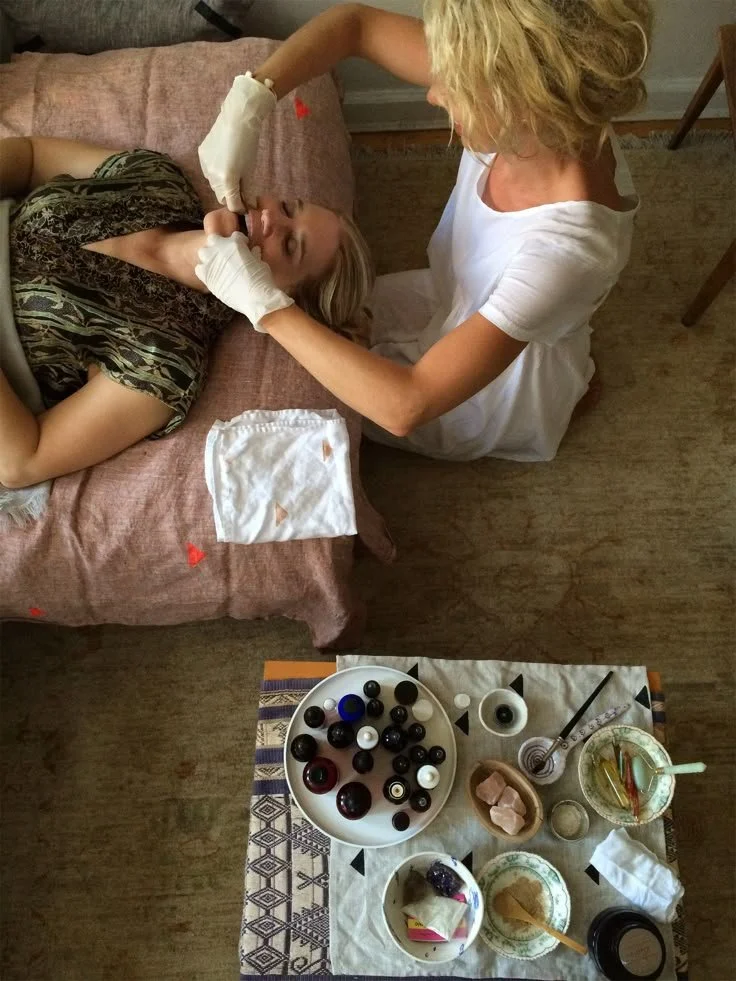
Image of Kristina Holey in action: a skin care specialist, with a focus on the scientific and holistic processes of the body.
Facial massage on its own deserves a separate article, as it provides the benefits of not only relaxation but jaw tension release, more ease of motion with facial expressions, a more lifted (“snatched”) appearance, and increased circulation—just to name a few. I think these beautiful benefits are due to the sheer amount of cranial nerves, muscles, and lymph nodes in the head and neck region of the body.
Though none of this makes massage psychotherapy, the question is why care directed toward our psychology is considered meaningful while deliberate care directed toward our physiology is so often dismissed as indulgence. We recognize that chronic stress affects the body, yet call practices that directly engage the body “pampering.”
In my practice, I don’t believe caring for the skin has to stop at the surface. Barrier function, hydration, inflammation, acne, and healthy aging can all be addressed while recognizing that the skin is also a sensory organ connected to an entire nervous system. Touch is not an interruption from the “real” treatment, but rather, an integral part of it. I purposely spend more than half of a facial administering grounding touch, even during acne facials.
After all, the skin is our largest organ. Not only does it act as a first line of defense against the outside world, but it is a sensory organ capable of experiencing pleasure. And just because the experience is enjoyable, does not make the it frivolous. Skin-to-skin contact and tactile pleasure trigger the release of several key neurotransmitters and hormones:
Oxytocin: Lowers systemic anxiety, builds interpersonal trust, and actively combats cellular aging.
Endorphins + dopamine: These act as the body's natural painkillers and mood lifters, generating a sense of calm and emotional well-being
Cortisol suppression: Pleasurable stimulation drives down cortisol (the primary stress hormone). Chronically high cortisol damages the body, so lowering it protects your tissues from wear and tear.
Perhaps we don’t need to make massage or facials more clinical to make them legitimate. We simply need to stop treating physiology as secondary to psychology. We tend to our thoughts, emotions, and inner lives because they are part of our health. Our bodies deserve the same attention through environmental manipulation and touch therapies.
Feeling at home in the body
Many of us have developed a distant relationship with our bodies. We move through our days without noticing what we are physically experiencing until something hurts. Somatic care gives us an opportunity to interrupt that distance.
For an hour, someone can lie still and experience the sensations of their body with the support of a practitioner. They might notice where they are bracing, where they feel tender, how deeply they are breathing, or what it feels like to receive care without having to respond.
Bodywork creates a form of care in which somatic listening and observation are part of the treatment. A practitioner pays attention not only to what is visible, but also to texture, temperature, tension, breath, sensitivity, and the body’s subtle responses.

Ida Pauline Rolf was a biochemist and the creator of the practice of Structural Integration, later termed Rolfing, a type of manual therapy that claims to aligning the human body's energy field and Earth's gravity.
This kind of attention cannot always be reduced to a prescription or protocol. It involves tending to someone in physical closeness and creating a space in which they can safely exist in their body.
Bodywork practitioners occupy a unique position because we work at the meeting point of the physical, emotional, and spiritual self. We cannot separate the skin from the person whose skin we are touching.
This experience doesn’t have to begin and end in a treatment room. Somatic care can also include self-massage, noticing your breath, placing a hand on a tense part of your body, or taking a few minutes to feel the stillness.
Sources
Moyer, C. A., Rounds, J., & Hannum, J. W. 2004. “A Meta-Analysis of Massage Therapy Research.” Psychological Bulletin, 1301, 318.
Kaada, B., & Torsteinbø, O. 1989. “Increase of Plasma Beta-Endorphins in Connective Tissue Massage.” General Pharmacology.
Field, T., Hernandez-Reif, M., Diego, M., Schanberg, S., & Kuhn, C. 2005. “Cortisol Decreases and Serotonin and Dopamine Increase Following Massage Therapy.” International Journal of Neuroscience, 11510, 13971413.
Hatayama, T., Kitamura, S., Tamura, C., Nagano, M., & Ohnuki, K. 2008. “The Facial Massage Reduced Anxiety and Negative Mood Status, and Increased Sympathetic Nervous Activity.” Biomedical Research, 296, 317320.
Schirmer, A., Croy, I., & Ackerley, R. 2023. “What Are CTactile Afferents and How Do They Relate to Affective Touch?” Neuroscience & Biobehavioral Reviews, 151, 105236.